
Lecture 2 - Part 1
Contents
Quantisation
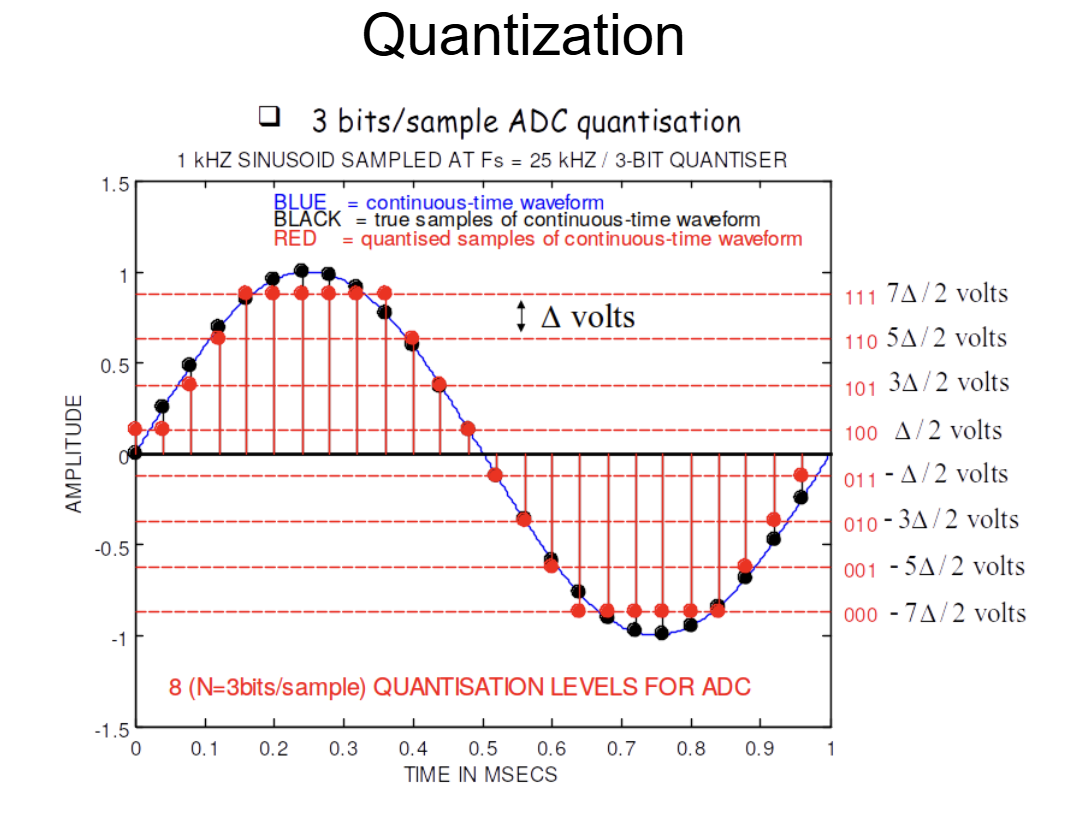
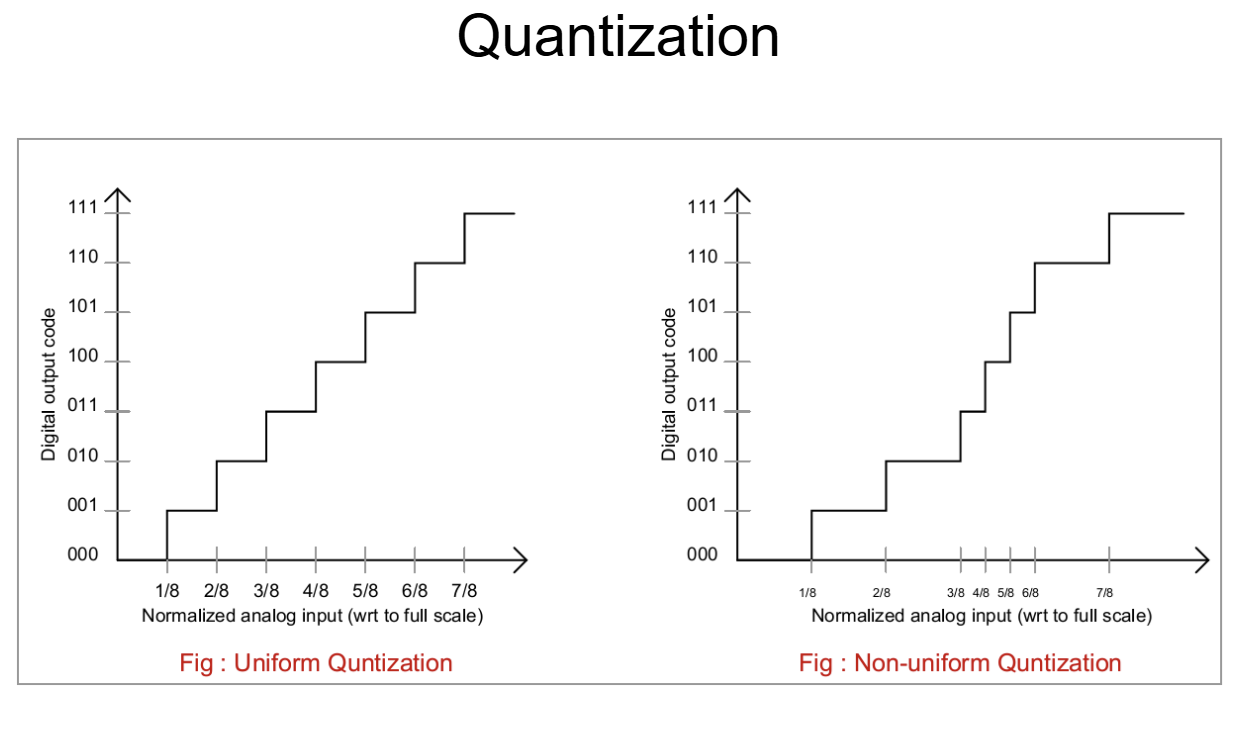
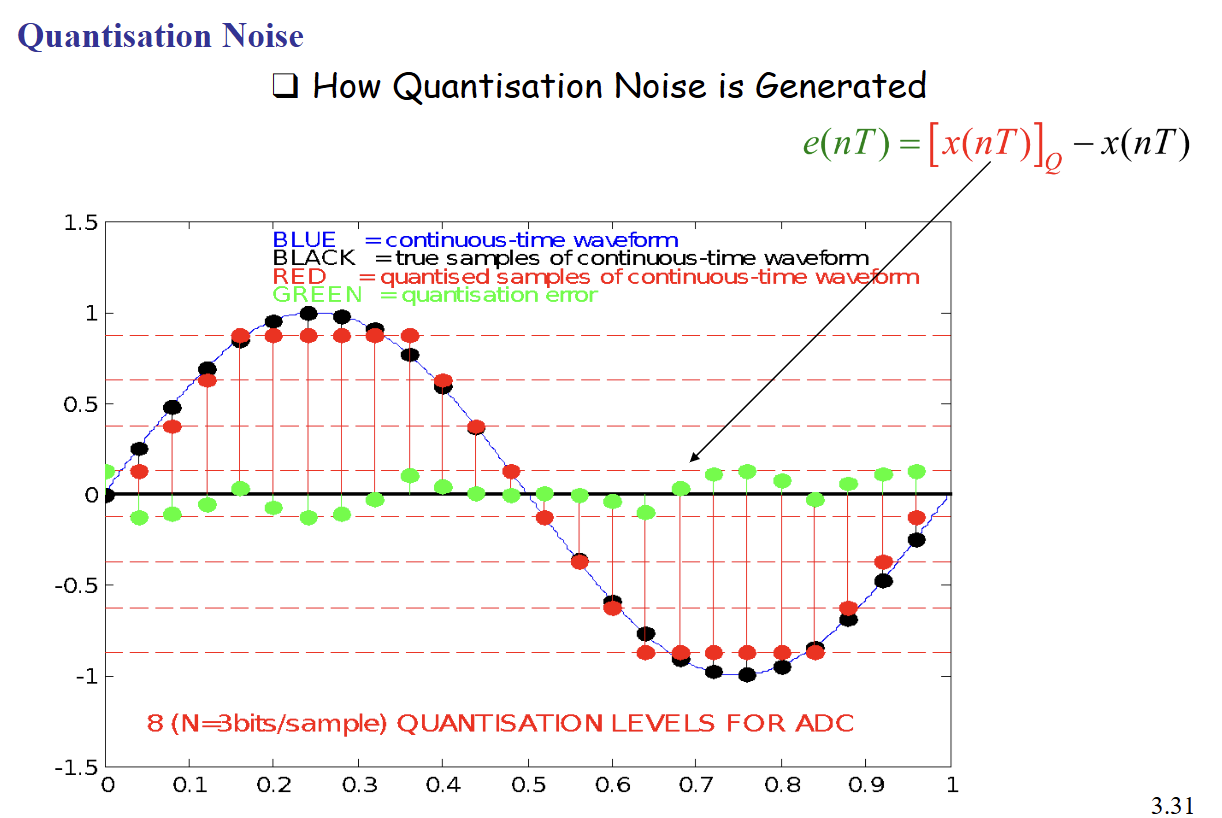
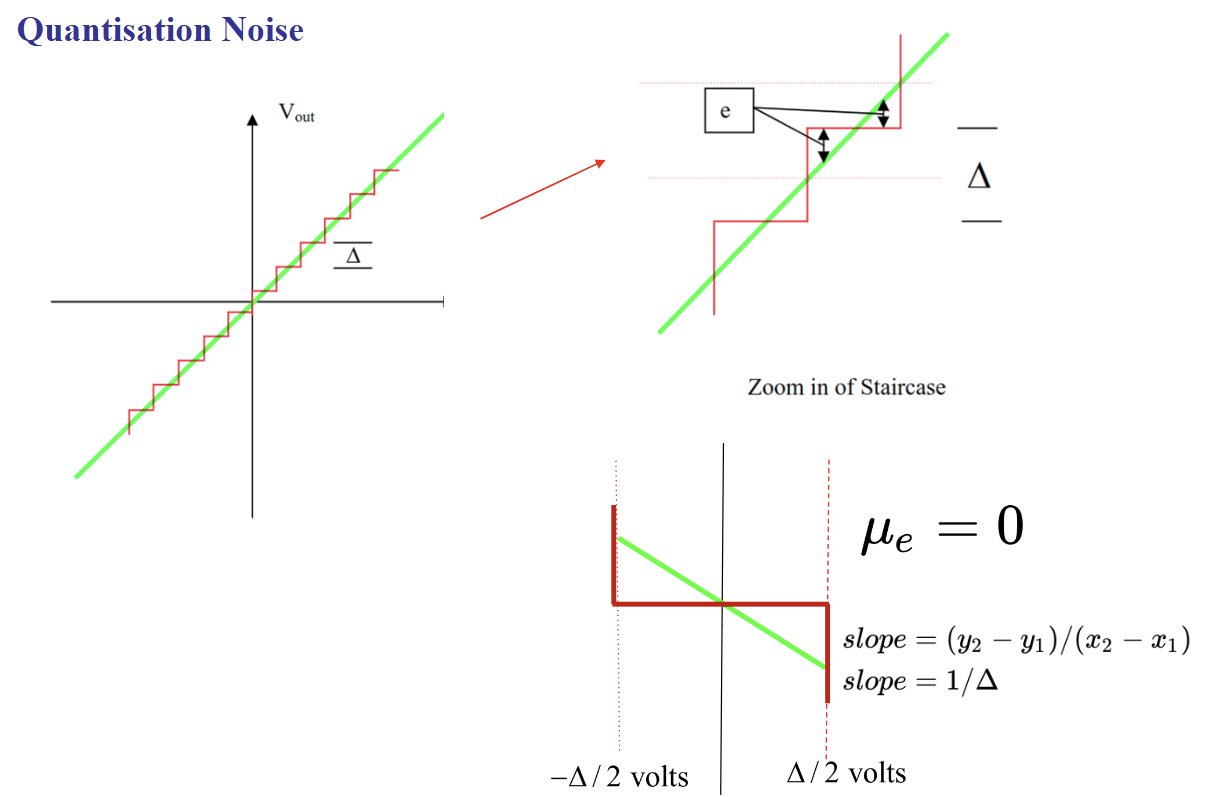
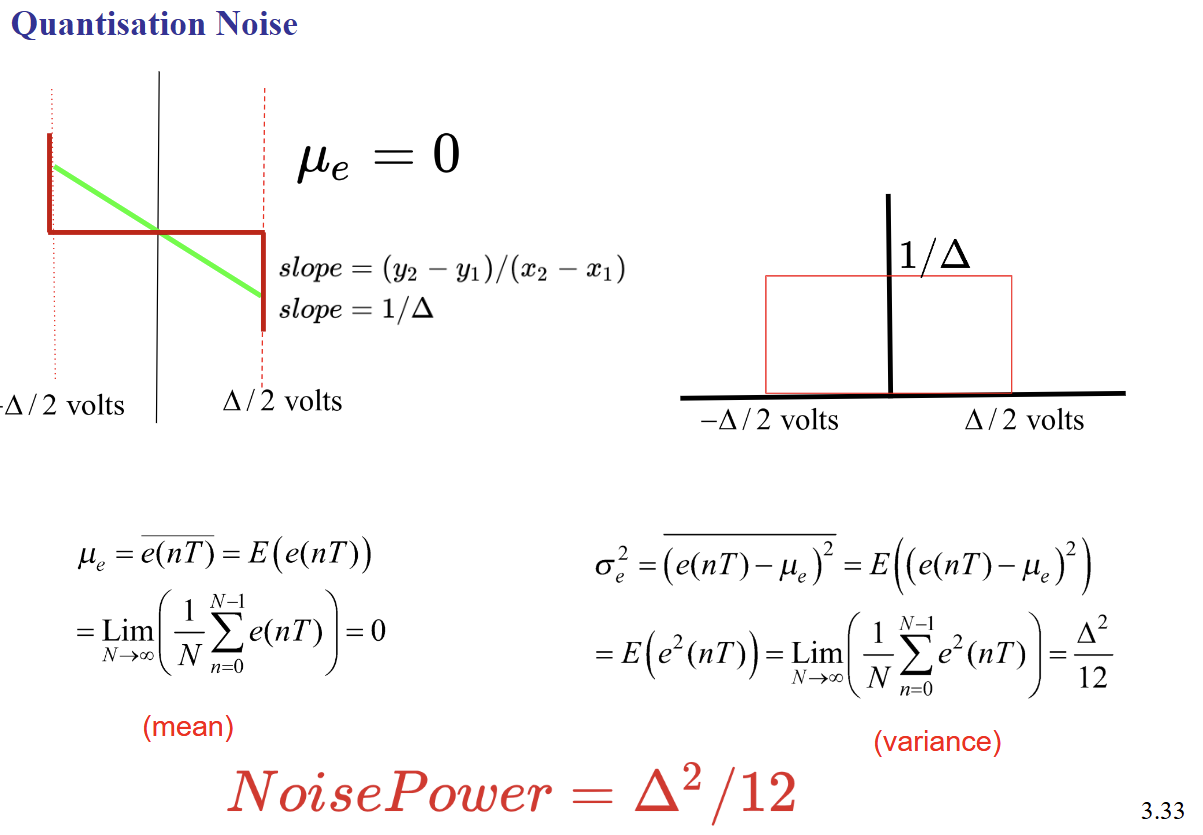
Signal-to-Quantisation-Noise-Ratio (SQNR)
Assume that an ADC has dynamic range volts and uses bits. The quantization step size is
The quantization noise power (uniform quantizer assumption) is
The RMS noise (standard deviation) is
The RMS value of a full-scale sine wave with peak is
Therefore the linear SNR (signal RMS divided by noise RMS) is
Substituting yields
In decibels:
Numerically this is typically written as:
So every extra bit in an ADC gives approximately a 6dB increase in the SNR of the ADC output SQNR.SQNR Problems and Solutions
Problem 1: Uniform Quantizer SQNR
A sinusoidal signal with amplitude is uniformly quantized using a 3-bit quantizer. Assume the signal is full-scale.
Questions:
- Calculate the quantization step size .
- Determine the maximum SQNR in dB.
Solution:
- Quantization step size:
For an -bit uniform quantizer covering full scale :
- Maximum SQNR for sinusoidal input:
Here :
Answer:
Problem 2: SQNR with Different Bit Depth
A full-scale sinusoidal signal is quantized using an 8-bit uniform quantizer.
Questions:
- What is the SQNR in dB?
- If the bit depth is increased to 12 bits, by how much does the SQNR improve?
Solution:
- 8-bit SQNR:
- 12-bit SQNR:
SQNR improvement:
Answer: 8-bit SQNR ≈ 50.9 dB, improvement with 12-bit ≈ 23 dB.
Problem 3: Quantization Noise Power
A full-scale sinusoidal signal with amplitude is quantized using a 4-bit uniform quantizer.
Questions:
- Find the quantization step size .
- Calculate the quantization noise power .
- Determine SQNR (linear, not dB).
Solution:
- Step size:
- Quantization noise power (uniform quantization):
- Signal power (sinusoid ):
- SQNR (linear):
Answer: